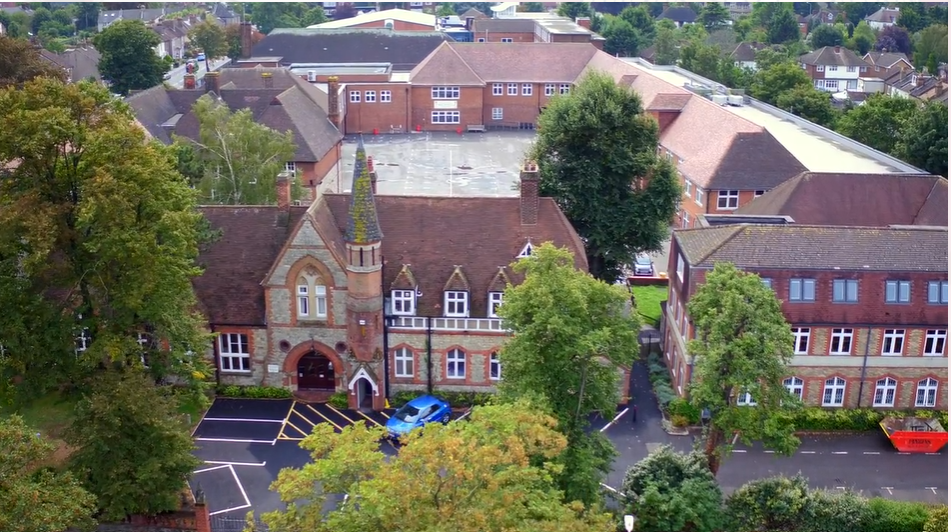
Dartford Grammar School is one of the oldest boys' grammar schools in Kent, with a history stretching back to the 16th century.
DARTFORD, KENT — Families across north-west Kent and swathes of south-east London are bracing for one of the most competitive entrance exams in the country this September, as Dartford Grammar School prepares to sit its annual intake through 180 places against a field of applicants facing some of the highest pass thresholds in the region.
Founded in the 16th century, Dartford Grammar School for Boys has built a reputation over four centuries as one of Kent's leading academic institutions, with GCSE and A-level results that regularly place it among the county's top performers and a steady stream of leavers progressing to Oxford and Cambridge. That pedigree, combined with strong pastoral care and an extensive sport, music and extra-curricular offering, has made the school a magnet for ambitious families well beyond its immediate catchment — and pushed competition for places to new extremes.
A Four-Part Test
Entry runs through the Kent Test, set by GL Assessment, which differs from the CSSE format used across the border in Essex. Candidates sit two one-hour papers: the first splits evenly between English and maths, each preceded by a short practice exercise; the second covers verbal reasoning, non-verbal reasoning and spatial reasoning — the last of these a Kent-specific addition that some national preparation resources overlook entirely.
All questions are multiple choice, with scores from the three assessed areas standardised and combined into an aggregate mark out of 423.
Pass Marks Among the Highest in Kent
According to 2025 entry data, the cutoff for applicants living within the school's catchment, or Zone A, sat at roughly 386 out of 423 — about 91 per cent. For families applying from outside the area, including the London boroughs that supply a significant share of candidates, the bar rose to approximately 404 out of 423, or around 96 per cent, meaning out-of-area pupils must answer nearly every question correctly to stand a realistic chance.
Education consultants suggest a practical benchmark of 125 marks or higher per paper, out of a possible 141, for in-area candidates to remain competitive, with out-of-area applicants advised to aim for 133 to 135 or above. Officials note that year-on-year variation means these figures should be treated as a guide rather than a guarantee.
Timeline for September's Sitting
Registration for the 2026 Kent Test, administered through Kent County Council and local primary schools rather than directly by the school itself, opens in June and closes in July. The exam itself falls on 11 September 2026, with results due to reach parents the following month. Families must still submit the Common Application Form by 31 October 2026 regardless of test outcome.
Preparation "Cannot Start Too Early," Tutors Say
With cut-offs running as high as 96 per cent, tutors and preparation specialists are urging families to begin structured work well ahead of the exam — ideally from Year 4, building to weekly timed papers in Year 5 and full mock exams under timed conditions each month during the first term of Year 6.
Verbal reasoning is flagged as a particular stumbling block: the format tests 21 distinct question types, from letter codes and analogies to hidden words and number codes, and rewards pupils who work through problems at pace — roughly one question every 37 seconds. Non-verbal reasoning, by contrast, is described as more pattern-based, with repeated rules and shapes that reward sustained practice. On the maths side, preparation specialists say the exam moves faster than typical school assessments and spans the full key stage 2 curriculum and beyond, including fractions, percentages, ratio, algebra and data handling.
Where Families Go Wrong
Several recurring errors are cited by those who coach children through the Kent Test. Chief among them is confusion over zone classification, with some out-of-area families unaware that their required score is markedly higher until late in the process. Others are said to underprepare for spatial reasoning, a component some generic 11+ resources exclude, or delay verbal reasoning practice on the assumption it can be picked up quickly close to the exam.
Perhaps most costly, according to preparation specialists, is a failure to practise under timed conditions until the final term before the test. With pass marks running at 91 to 96 per cent, they warn, pace becomes as decisive as accuracy — and pupils who have never sat a full paper against the clock can lose 10 to 20 marks simply through slow working under pressure.
Figures cited are based on 2025 entry data and are subject to change for the 2026 admissions cycle. Families are advised to confirm current requirements with Kent County Council and Dartford Grammar School directly.
Where does your child stand?
Our free 15-minute check scores Maths, English, Verbal and Non-Verbal Reasoning against your child’s year, and shows what to work on first.